


Safety
KORSUVA® HAS AN ACCEPTABLE SAFETY PROFILE AND IS GENERALLY WELL TOLERATED1


Adverse reactions attributed to the treatment with KORSUVA® in haemodialysis (HD) patients:1
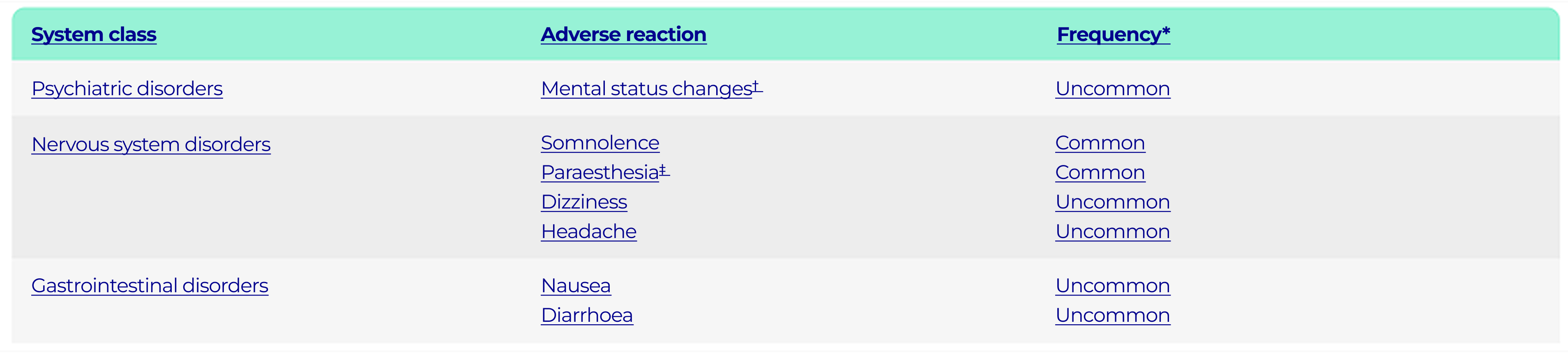
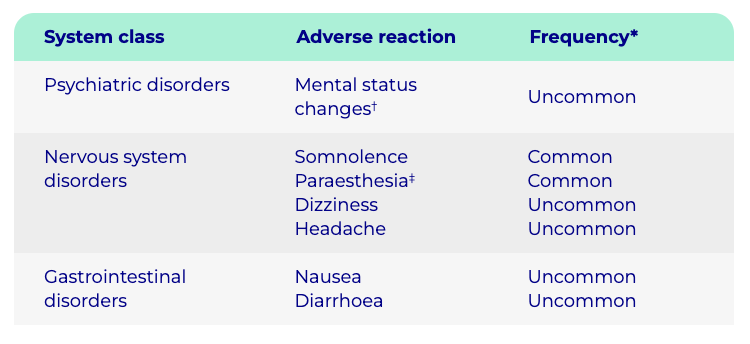
Somnolence1
The vast majority of these events were mild or moderate in severity. Somnolence occurred within the first 3 weeks of treatment and tended to subside with continued dosing. The likelihood of somnolence may increase when KORSUVA® is concomitantly used with other medicinal products.¶
Dizziness1
The vast majority of these events were mild or moderate in severity. Dizziness occurred within the first 9 weeks of treatment and tended to subside with continued dosing. The likelihood of dizziness may increase when KORSUVA® is concomitantly used with other medicinal products.¶
Mental status change†1
The vast majority of these events were mild or moderate in severity.
KORSUVA® HAS A LOW LIKELIHOOD OF DRUG–DRUG INTERACTIONS1
Data from clinical or preclinical studies suggest that KORSUVA®:

Exhibits low plasma protein binding, which limits the potential for displacement of other highly protein-bound drugs1

Is not a substrate, inhibitor of major drug transporters or inducer of major cytochrome P450 enzymes, which limits the potential for drug–drug interactions1
Is predominantly excreted unchanged by the kidney, with no evidenced metabolism by the liver1
STUDIES OF KORSUVA® DEMONSTRATED NO ABUSE POTENTIAL AND NO SIGNS OF PHYSICAL DEPENDENCE2

No adverse events (AEs) of euphoria,
hallucinations or dysphoria were observed in
the Phase 3 (KALM-1) and Phase 2 (CLIN2101) studies of KORSUVA® in HD patients with
moderate-to-severe pruritus2,3

No signs of potential physical
dependence or AEs related to withdrawal
were observed in the Phase 3 (KALM-1) study of KORSUVA® in
HD patients with moderate-to-severe pruritus.2
Physical dependence was measured
using ShOWS† and OOWS‡2

References & footnotes

Footnotes
*The frequency is classified as common (≥ 1/100 to < 1/10) and uncommon (≥ 1/1,000 to < 1/100).
† Mental status changes included MedDRA preferred terms of confusional state and mental status changes.
‡Paraesthesia included MedDRA preferred terms of paraesthesia, hypoesthesia, paraesthesia oral and hypoesthesia oral.
¶Concurrent administration of medicinal products such as sedating antihistamines, opioid analgesics or other CNS depressants (e.g. clonidine, ondansetron, gabapentin, pregabalin, zolpidem, alprazolam, sertraline, trazodone) may increase the likelihood of dizziness and somnolence.
Abbreviations
AEs, adverse events; CNS, central nervous system; HD, haemodialysis; MedDRA, Medical dictionary for regulatory activities; OOWS, objective opioid withdrawal scale; ShOWS; short opioid withdrawal scale.
References
- Korsuva UAE SmPC. Korsuva KSA SmPC.
- Fishbane S, et al. A Phase 3 Trial of Difelikefalin in Hemodialysis Patients with Pruritus. New Engl J Med. 2020;382:222–32.
- Fishbane S, et al. Randomized Controlled Trial of Difelikefalin for Chronic Pruritus in Hemodialysis Patients. Kidney Int Rep. 2020;5:600-10.
GCC-DFK-2500011 | Date of preparation: October 2025