


Women's Health


Treatment
Effective treatment should correct anaemia and replenish iron stores4

Oral iron is the first-line treatment for iron deficiency (ID)/iron deficiency anaemia (IDA) but may not be appropriate for all patients4

IV iron is indicated when there is intolerance to oral iron or an inadequate response, or rapid iron delivery is required. ID diagnosis must be based on laboratory tests5

If patients do not respond to oral iron therapy (i.e. an Hb increase <1 g/dL by 4 weeks) consider switching to IV iron4
EHA guidelines: ID/IDA treatment algorithm4
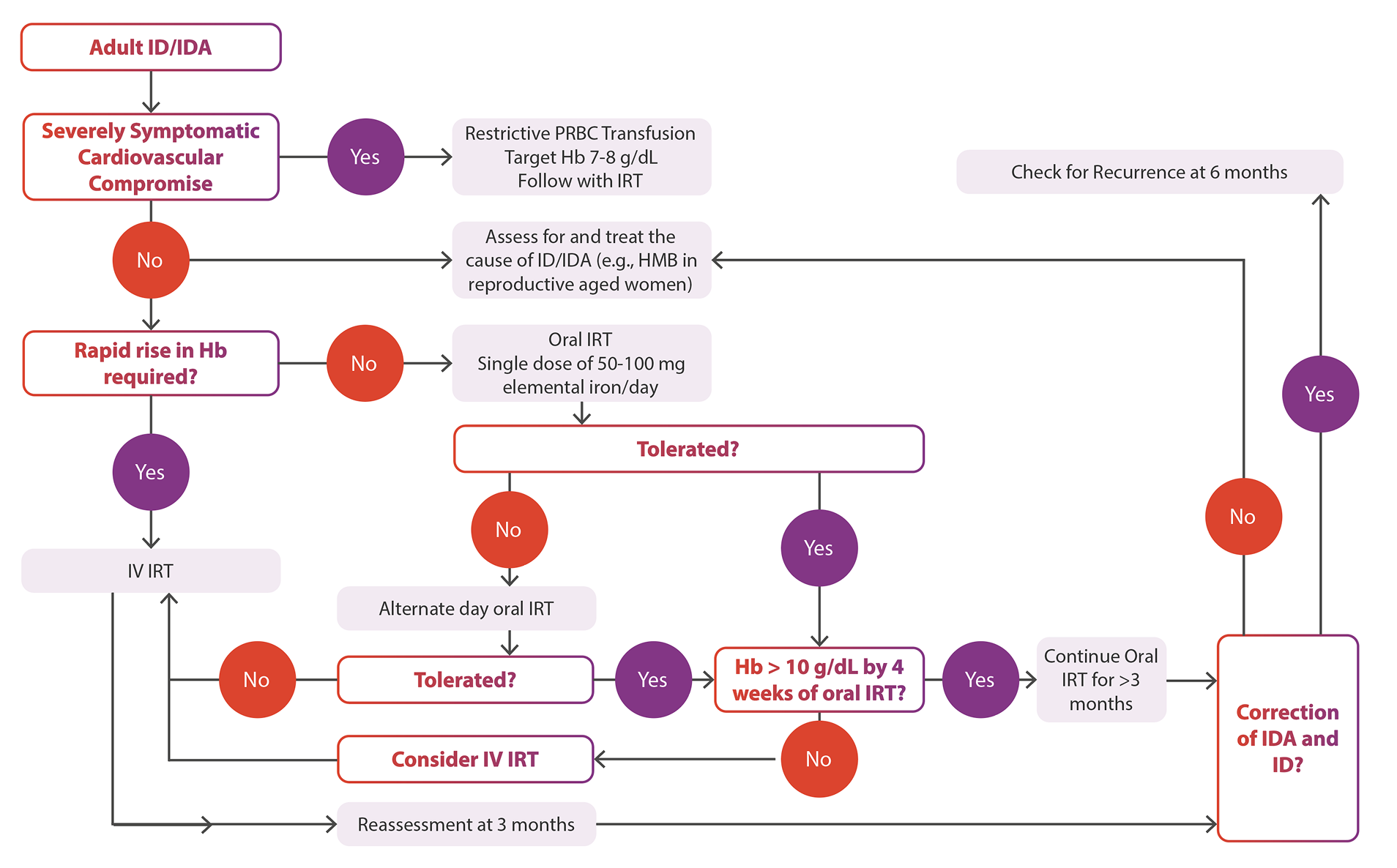
Reproduced from Iolascon et al. 2024.
Detect ID early before progression to anaemia4,8


Otherwise healthy women with ID/IDA
European Hematology Association guidelines4
IV iron should be considered when:
- there is intolerance to oral iron or lack of compliance
- there is an inadequate response to oral iron (Hb increase <1 g/dL by 4 weeks)
- rapid iron delivery is required
Women with abnormal uterine bleeding
European Hematology Association guidelines4
IV iron treatment is recommended in women with abnormal uterine bleeding
Pregnancy
British Society for Haematology guidelines6
In pregnancy, IV iron should be considered:
- from the second trimester onwards for women with confirmed IDA who are intolerant of, or do not to respond to, oral iron
- in women who present after 34 weeks' gestation with confirmed IDA and Hb <10 g/dL
IV iron products should not be used during pregnancy unless clearly necessary. IV iron treatment should be confined to the 2nd and 3rd trimester if the benefit is judged to outweigh the potential risk to mother and the foetus.5

Postpartum
British Society for Haematology guidelines6
IV iron should be considered postpartum:
- in women who are previously intolerant of, or do not respond to, oral iron
- where the severity of symptoms of anaemia requires prompt management
Is it time to explore IV iron treatment for some of your ID patients?
To ensure your patients have access to IV iron treatment, refer them to an appropriate infusion centre.
References & footnotes

Abbreviations
Hb, haemoglobin; HMB, heavy menstrual bleeding; ID, iron deficiency; IDA, iron deficiency anaemia; IRT, iron replacement therapy; IV, intravenous; PRBC, packed red blood cells.
References
- Dugan C et al. The misogyny of iron deficiency. Anaesthesia 2021;76(Suppl 4):56–62.
- Favrat B et al. Evaluation of a single dose of ferric carboxymaltose in fatigued, iron-deficient women – PREFER a randomized, placebo-controlled study. PLoS One 2014;9(4):e94217.
- Van Wyck DB et al. Large-dose intravenous ferric carboxymaltose injection for iron deficiency anemia in heavy uterine bleeding: a randomized, controlled trial. Transfusion 2009;49(12):2719–28.
- Iolascon A et al. Recommendations for diagnosis, treatment, and prevention of iron deficiency and iron deficiency anemia. Hemasphere 2024;8(7):e108.
- Ferinject® Summary of Product Characteristics.
- Pavord S et al. UK guidelines on the management of iron deficiency in pregnancy. Br J Haematol 2020;188(6):819–30.
- Breymann C et al. Diagnosis and treatment of iron‑deficiency anaemia in pregnancy and postpartum. Arch Gynecol Obstet 2017;296(6):1229–34.
A complete copy of the cited publications may be requested from CSL in your country.