


Efficacy
KORSUVA® SIGNIFICANTLY REDUCED ITCH INTENSITY COMPARED TO PLACEBO2


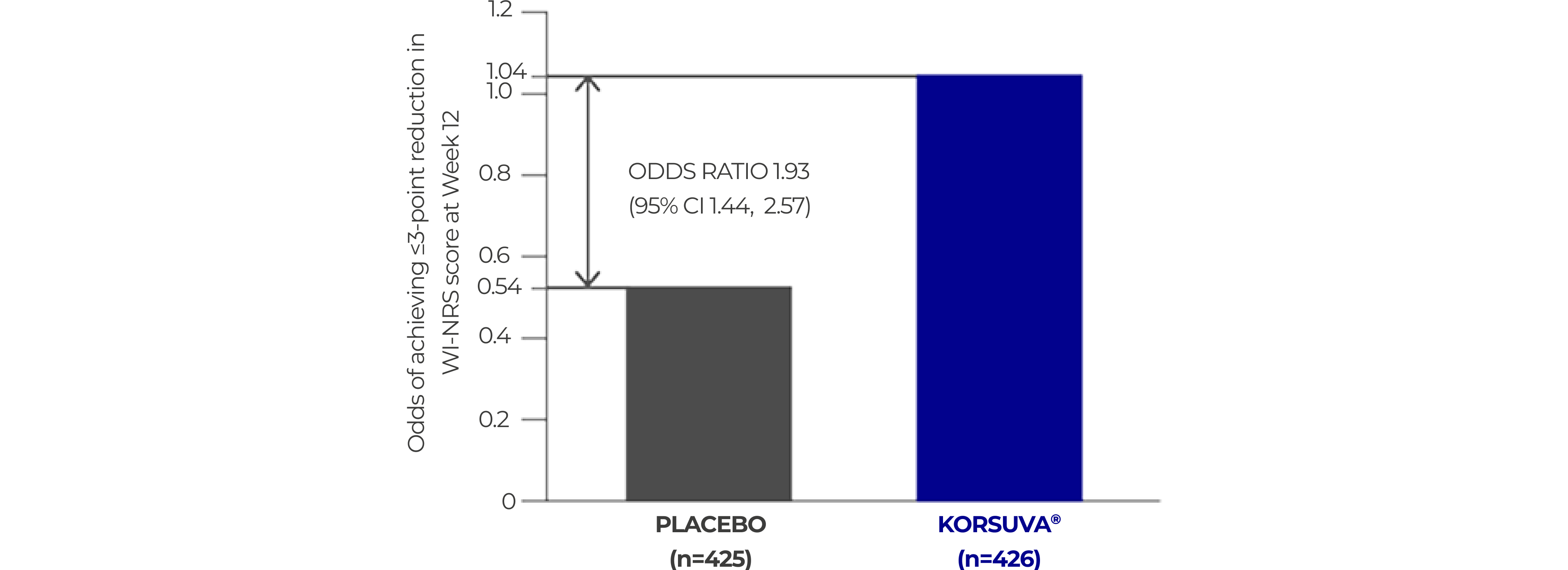
At Week 12, the probability of achieving (vs not) a ≥3-point reduction in Worst Itch Numeric Rating Scale* (WI‑NRS) score was almost twice as large with KORSUVA® compared with placebo.2
In a pooled analysis of two Phase 3 trials (KALM-1 and KALM-2), after Week 1 significantly more patients achieved a ≥3-point improvement in WI‑NRS and sustained at all time points up to Week 12, with 51.1% of patients on KORSUVA® compared with 35.2% of patients on placebo.2
ODDS OF ACHIEVING ≥3-POINT IMPROVEMENT IN WI-NRS* SCORE AT WEEK 122
Adapted from Topf J et al. 20222
Pooled KALM-1 and KALM-2 methodology2

KALM-1 (N=378) and KALM-2 (N=473) were randomised, double-blind, multi-centre, placebo-controlled, Phase 3 trials. There were 851 randomised patients in the pooled analysis (KORSUVA® n=426; placebo n=425).
Pooled analysis outcomes
- Achievement of ≥3-point improvement in WI‑NRS score*
- Subgroup analyses for WI‑NRS response at Week 12
- Achievement of WI‑NRS complete response† (≥80% of weekly WI‑NRS scores equal to 0 or 1 for the preceding week)
- Achievement of ≥15-point improvement in Skindex-10 total score‡
- Achievement of ≥5-point improvement in 5-D itch total score‡
*Missing values were imputed using multiple imputation under missing at random assumption.
†In the analysis of complete response, missing values were treated as non-responders.
‡Skindex-10 and 5-D itch responses were analysed without imputation for missing values.
KORSUVA® SIGNIFICANTLY IMPROVED ITCH-RELATED QUALITY-OF-LIFE COMPARED TO PLACEBO2
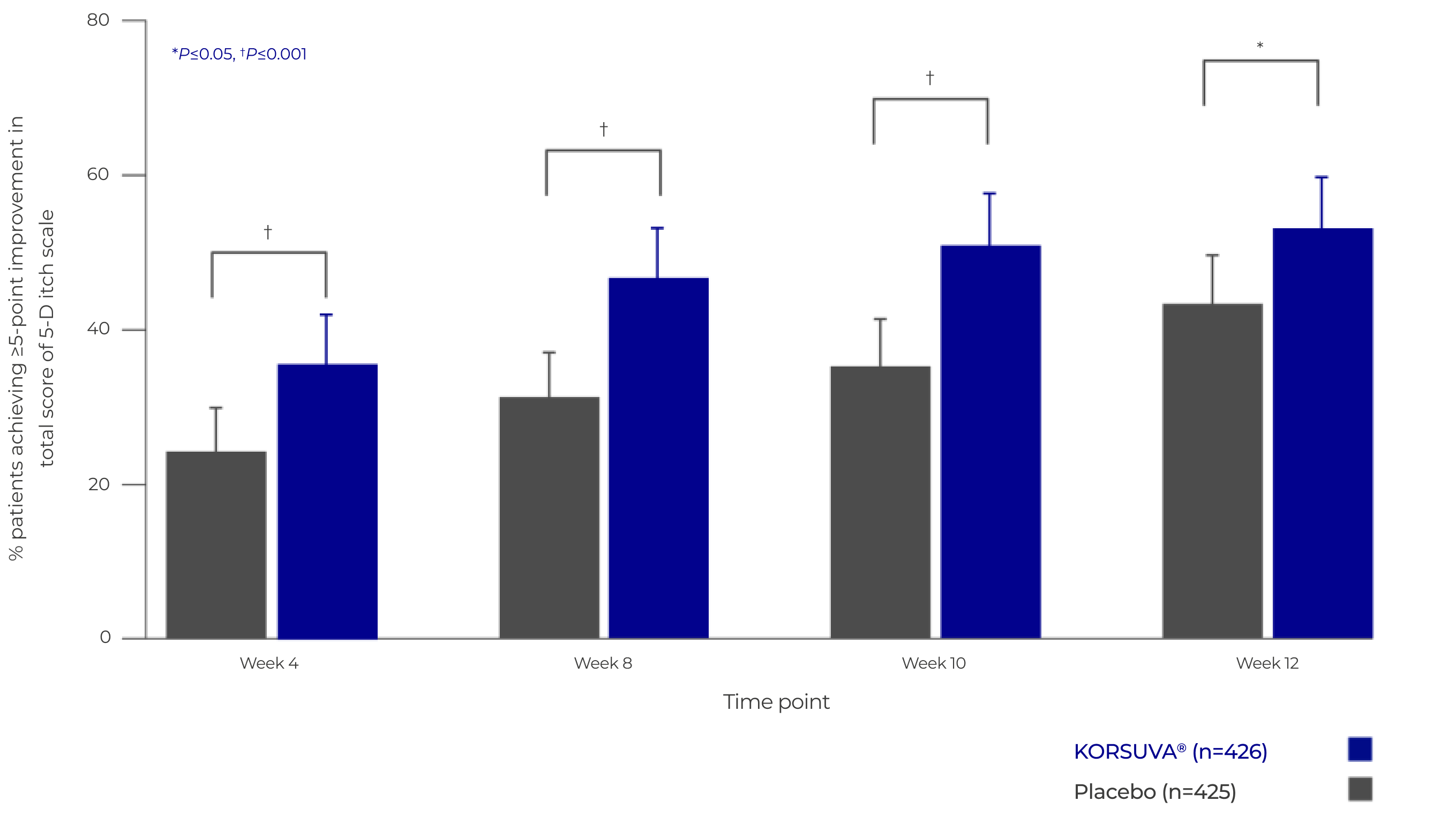
KORSUVA® is associated with improvements in itch-related quality-of-life from Week 4 that continued through to Week 12, as it significantly increased the proportion of patients achieving a ≥5-point improvement in 5-D itch‡ total score.2
CLINICALLY SIGNIFICANT CHANGE IN 5-D ITCH‡ SCORE TO WEEK 122
Adapted from Topf et al. 20222
KORSUVA® SIGNIFICANTLY IMPROVED ITCH-RELATED QUALITY-OF-LIFE COMPARED TO PLACEBO2
KORSUVA® is associated with improvements in itch-related quality-of-life from Week 4 that continued through to Week 12, as it significantly increased the proportion of patients achieving a ≥5-point improvement in Skindex-10§ total score.2
CLINICALLY SIGNIFICANT CHANGE IN SKINDEX-10§ SCORE TO WEEK 12
(POOLED KALM-1 AND KALM-2)2
Adapted from Topf et al. 20222
Pooled KALM-1 and KALM-2 methodology2
KALM-1 (N=378) and KALM-2 (N=473) were randomised, double-blind, multi-centre, placebo-controlled, Phase 3 trials. There were 851 randomised patients in the pooled analysis (KORSUVA® n=426; placebo n=425).
Pooled analysis outcomes
- Achievement of ≥3-point improvement in WI‑NRS score*
- Subgroup analyses for WI‑NRS response at Week 12
- Achievement of WI‑NRS complete response† (≥80% of weekly WI‑NRS scores equal to 0 or 1 for the preceding week)
- Achievement of ≥15-point improvement in Skindex-10 total score‡
- Achievement of ≥5-point improvement in 5-D itch total score‡
*Missing values were imputed using multiple imputation under missing at random assumption.
†In the analysis of complete response, missing values were treated as non-responders.
‡Skindex-10 and 5-D itch responses were analysed without imputation for missing values.
KORSUVA® MAINTAINED IMPROVEMENTS IN ITCH-RELATED QUALITY-OF-LIFE OVER 64 WEEKS IN A DOUBLE-BLIND AND OPEN-LABEL STUDY2
Improvements in 5-D itch response continued over a 52-week open-label extension
(OLE) of pooled KALM-1 and KALM-2.2
Marked improvement in 5-D itch‡ scores emerged in patients who switched from placebo to KORSUVA® within a few weeks.2
MEAN IMPROVEMENT IN 5-D ITCH‡ TOTAL SCORE DURING DOUBLE-BLIND AND OLE PHASES
(KALM-1 AND KALM-2 OLE)2
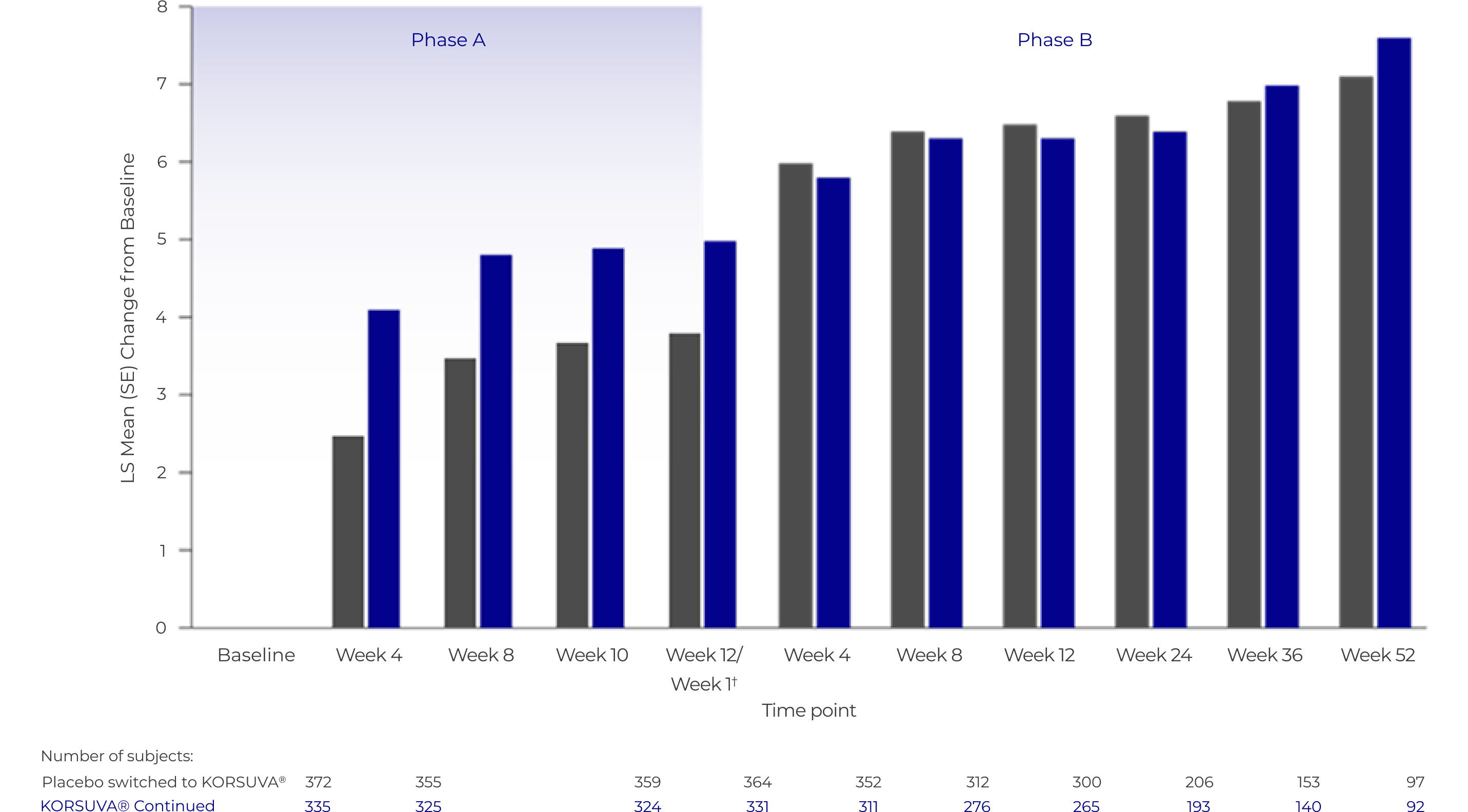
Phase A: KORSUVA® vs Placebo – The first 12 weeks of the study was double-blinded with patients receiving either KORSUVA® or placebo.
Phase B: There was an open-label extension to the study for up to 1 year where patients from Phase 1 either continued KORSUVA® or were switched to KORSUVA® from placebo.
Adapted from Topf et al. 20222

KORSUVA® continued

Placebo switched to KORSUVA®
POOLED KALM-1 AND KALM-2 OLE METHODOLOGY2
Long-term quality-of-life and pooled safety data from the placebo-controlled and open-label extension (OLE) periods of the Phase 3 KALM-1 and KALM-2 trials.
Haemodialysis (HD) patients with moderate-to-severe CKD-associated Pruritus were randomised to IV KORSUVA® 0.5 μg/kg or placebo three times per week for 12 weeks, followed by a ≤52-week OLE phase in which all patients received IV KORSUVA® 0.5 μg/kg three times per week. Itch-related quality-of-life was assessed with the 5-D itch scale. Safety was evaluated based on safety assessments and adverse events (AEs).
References & footnotes

Footnotes
*WI‑NRS is a validated 11-point scale ranging from 0-10 where 0 represents ‘no itching’ and 10 ‘worst itch imaginable’.3,4
‡The 5-D itch scale was designed to be useful as an outcome measure in clinical trials and has been validated in patients with chronic pruritus. The 5-D itch scale assesses 5 dimensions of itch (duration, degree, direction, disability, and distribution). A quantitative scale (5–25) lower scores indicate better itch-related quality-of-life.5 ≥5-point improvement in 5-D itch total score was defined as a clinically meaningful response.2
§The Skindex-10 scale was developed specifically for assessing itch-related quality-of-life across 3 domains (disease, mood/emotional stress, and social functioning) in HD patients with pruritus. Patients rank their itch or quality-of-life elements related to itch from 0 (never bothered) to 6 (always bothered) Quantitative scale (0-60); lower scores indicate better itch-related QoL.2,6
≥15-point improvement in Skindex-10 total score was defined as a clinically meaningful response.2
¶This graph does not show the 2-week discontinuation process for those patients who did not move to Phase B (the extension study) from Phase A.2
Abbreviations
AEs, adverse events; CI, confidence interval; CKD-associated Pruritus, Chronic Kidney Disease-associated Pruritus; HD, haemodialysis; IV, intravenous; LS, least square; OLE, open label extension; SE, standard error; WI-NRS, Worst Itch Numeric Rating Scale.
References
- Korsuva UAE SmPC. Korsuva KSA SmPC.
- Topf J, et al. Efficacy of Difelikefalin for the Treatment of Moderate to Severe Pruritus in Hemodialysis Patients: Pooled Analysis of KALM-1 and KALM-2 Phase 3 Studies. Kidney Med. 2022;4(8):100512.
- Mathur VS, et al. A longitudinal study of uremic pruritus in hemodialysis patients. Clin J Am Soc Nephrol. 2010;5:1410–1419.
- Phan NQ, et al. Assessment of pruritus intensity: prospective study on validity and reliability of the visual analogue scale, numerical rating scale and verbal rating scale in 471 patients with chronic pruritus. Acta Derm Venereol. 2012;92:502–507.
- Elman S, et al. The 5-D itch scale: a new measure of pruritus. Br J Dermatol. 2010;162:587–93.
- Weiner DE, et al. Safety and Effectiveness of Difelikefalin in Patients With Moderate-to-Severe Pruritus Undergoing Hemodialysis: An Open-Label, Multicenter Study. Kidney Med. 2022;4(10):100542.
GCC-DFK-2500011 | Date of preparation: October 2025