


Role of Iron


Iron matters for energy production in the heart2,3

- The heart has the highest energy need of any organ in the body4,5
- Cardiomyocytes contain many mitochondria to produce adequate energy4,6
- Cardiomyocytes are particularly sensitive to iron depletion because they have a high energy demand3

In an in vitro model, iron deficiency impaired contractility of human cardiomyocytes through decreased mitochondrial function7

Iron deficiency can expose HF patients to risks, including:*
- Reduced HRQoL8-10
- Reduced exercise capacity11-13
- Increased risk of hospitalisation10
- Increased mortality11,14-16
Explore how iron deficiency matters in HF
The effect of cardiomyocyte function

In an in vitro model, iron deficiency impaired contractility of human cardiomyocytes through decreased mitochondrial function7
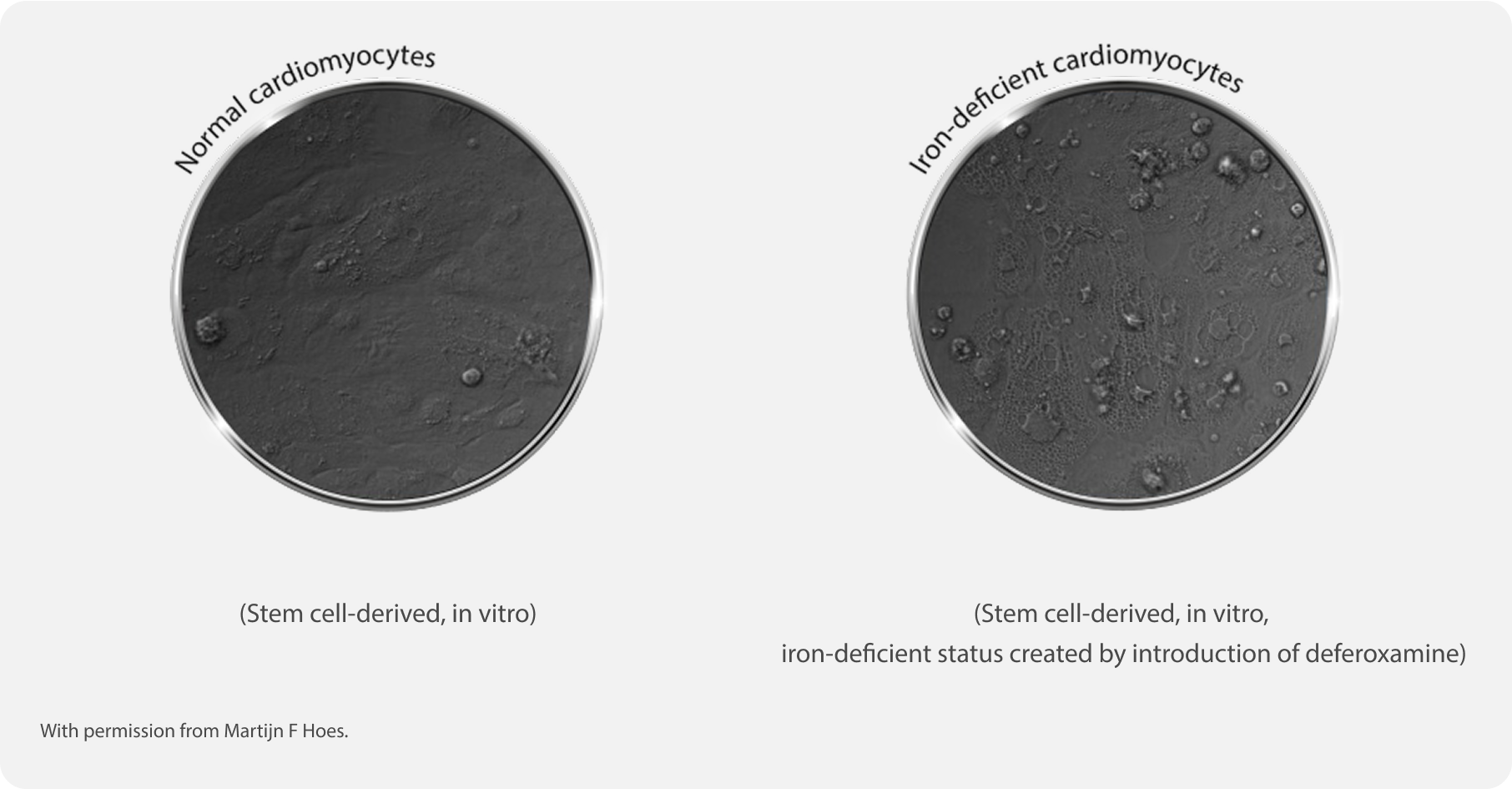
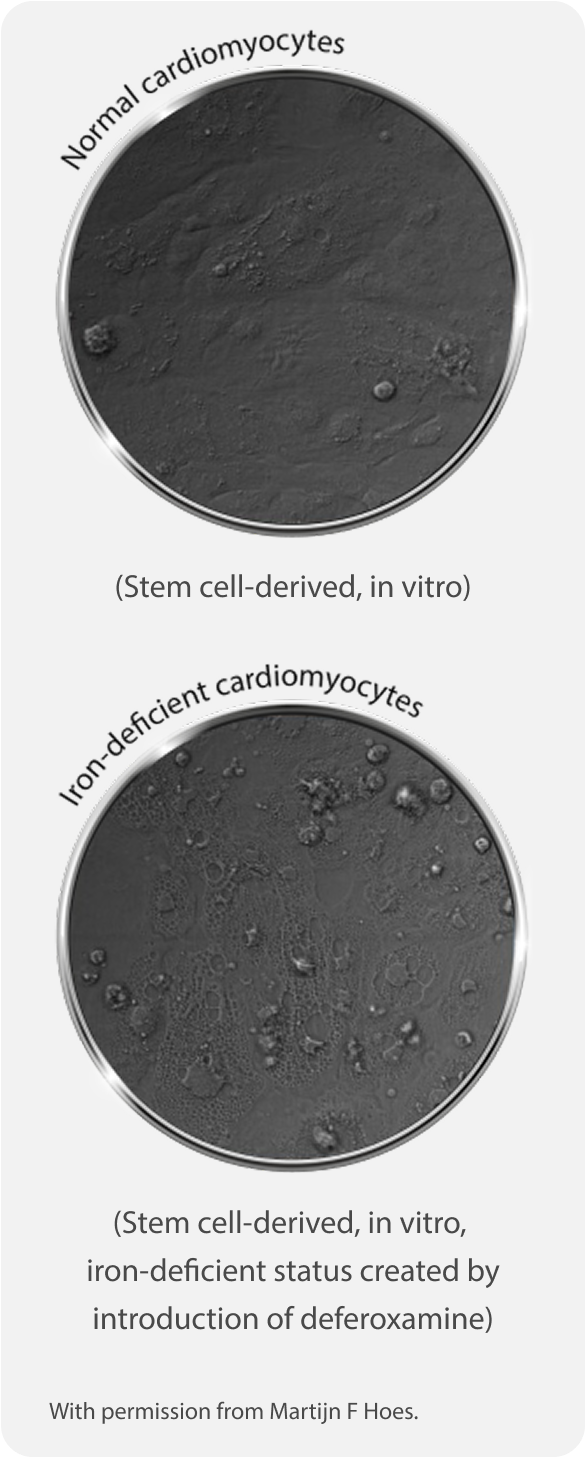
According to a 2018 in vitro study,7* depleting cardiomyocytes of iron led to mitochondrial dysfunction and...
- 74% reduction in cellular ATP levels (P<0.0001)7
- 43% reduction in cardiomyocyte contractile force (P<0.05)7
*The study used human embryonic stem cell-derived cardiomyocytes. The iron-deficient status was created by introduction of deferoxamine.7
ATP, adenosine triphosphate.
ATP, adenosine triphosphate.
Urgency to treat
There is no time to lose for HF patients with iron deficiency

Around 50% of HF patients die within five years of diagnosis, irrespective of iron deficiency17†

Studies have shown that iron deficiency is very common in patients with HF, reporting a prevalence of 37–62%14,15,18,19

Iron deficiency in HF is underdiagnosed and undertreated20

Causes of iron deficiency in HF
Iron deficiency in HF can have multiple causes, including:

Reduced iron stores
- Low dietary iron21
- Impaired GI absorption21
- GI blood loss, including drug-related bleeding21 (e.g., from acetyl salicylic acid and anticoagulants)22

Reduced iron mobilisation
- Hepcidin is a peptide hormone produced primarily by the liver and secreted into the circulation that serves as a key regulator of whole-body iron homeostasis23
- Increased levels of inflammatory cytokines in HF cause hepcidin upregulation, resulting in impaired iron transport into the blood and entrapment of iron in the macrophages (liver and reticuloendothelial cells)24
GI, gastrointestinal; HF, heart failure.



References & footnotes

Footnotes
*Compared with HF patients who are not iron-deficient.
†Based on three population based cohort studies - (i): study conducted in Olmstead County, Minnesota to determine the impact of HF complicating myocardial infarction on all-cause and cause-specific mortality (n=2596);27 (ii): study to determine patients with a diagnosis of HF between 1979 and 2000 in Olmstead County, Minnesota;28 (iii): community surveillance study assessing contemporary trends in the incidence rates of HF between 2000 and 2010, categorised as HFrEF or HFpEF, and cause-specific hospitalisation and mortality (n=2762).29
Abbreviations
HF, heart failure; HFpEF, heart failure with preserved ejection fraction; HFrEF, heart failure with reduced ejection fraction; HRQoL, health-related quality of life; ID, iron deficiency; IV, intravenous.
References
- Ferinject UAE SmPC. Ferinject KSA SmPC.
- Paul BT et al. Mitochondria and iron: current questions. Expert Rev Hematol 2017;10(1):65–79.
- Paterek A et al. Iron and the heart: a paradigm shift from systemic to cardiomyocyte abnormalities. J Cell Physiol 2019;234(12):21613–29.
- Neubauer S. The failing heart—an engine out of fuel. N Engl J Med 2007;356(11):1140–51.
- Pascual F, Coleman RA. Fuel availability and fate in cardiac metabolism: a tale of two substrates. Biochim Biophys Acta 2016;1861(10):1425–33.
- Brown DA et al. Expert consensus document: mitochondrial function as a therapeutic target in heart failure. Nat Rev Cardiol 2017;14(4):238–50.
- Hoes MF et al. Iron deficiency impairs contractility of human cardiomyocytes through decreased mitochondrial function. Eur J Heart Fail 2018;20(50):910–9.
- Enjuanes C et al. Iron deficiency and health-related quality of life in chronic heart failure: results from a multicentre European study. Int J Cardiol 2014;174(2):268–75.
- Wienbergen H et al. Usefulness of iron deficiency correction in management of patients with heart failure [from the Registry Analysis of Iron Deficiency-Heart Failure (RAID-HF) registry]. Am J Cardiol 2016;118(12):1875–80.
- Comin-Colet J et al. Iron deficiency is a key determinant of health-related quality of life in patients with chronic heart failure regardless of anaemia status. Eur J Heart Fail 2013;15(10):1164–72.
- Martens P et al. Impact of iron deficiency on exercise capacity and outcome in heart failure with reduced, mid-range and preserved ejection fraction. Acta Cardiol 2018;73(2):115–23.
- von Haehling S et al. Prevalence and clinical impact of iron deficiency and anaemia among outpatients with chronic heart failure: the PrEP registry. Clin Res Cardiol 2017;106(6):436–43.
- Jankowska EA et al. Iron deficiency predicts impaired exercise capacity in patients with systolic chronic heart failure. J Card Fail 2011;17(11):899–906.
- Jankowska EA et al. Iron deficiency: an ominous sign in patients with systolic chronic heart failure. Eur Heart J 2010;31(15):1872–80.
- Klip IT et al. Iron deficiency in chronic heart failure: an international pooled analysis. Am Heart J 2013;165(4):575–82.
- Yeo JT et al. Iron deficiency in a multi-ethnic Asian population with and without heart failure: prevalence, clinical correlates, functional significance and prognosis. Eur J Heart Fail 2014;16(10):1125–32.
- Benjamin EJ et al. Heart disease and stroke statistics-2018 update: a report from the American Heart Association. Circulation 2018;137(12):e67–492.
- Okonko DO et al. Disordered iron homeostasis in chronic heart failure: prevalence, predictors, and relation to anaemia, exercise capacity, and survival. JACC 2011;58(12):1241–51.
- van der Wal HH et al. Iron deficiency in worsening heart failure is associated with reduced estimated protein intake, fluid retention, inflammation, and antiplatelet use. Eur Heart J 2019;40(44):3616–25.
- Becher PM et al. Phenotyping heart failure patients for iron deficiency and use of intravenous iron therapy: data from the Swedish Heart Failure Registry. Eur J Heart Fail 2021;23(11):1844–54.
- Jankowska EA et al. Iron deficiency and heart failure: diagnostic dilemmas and therapeutic perspectives. Eur Heart J 2013;34(11):816–29.
- Ghali JK. Anaemia and heart failure. Curr Opin Cardiol 2009;24(2):172–8.
- Collins JF et al. Hepcidin regulation of iron transport. J Nutr 2008;138(11):2284–8.
- Anand IS, Gupta P. Anaemia and iron deficiency in heart failure: current concepts and emerging therapies. Circulation 2018;138(1):80–98.
- McDonagh TA et al. 2021 ESC Guidelines for the diagnosis and treatment of acute and chronic heart failure. Eur Heart J 2021;42(36):3599–726.
- McDonagh TA et al. 2023 Focused Update of the 2021 ESC Guidelines for the diagnosis and treatment of acute and chronic heart failure. Eur Heart J 2023;44(37):3627–39.
- Gerber Y et al. Mortality associated with heart failure after myocardial infarction: a contemporary community perspective. Circ Heart Fail 2016;9(1):e002460.
- Roger VL et al. Trends in heart failure incidence and survival in a community-based population. JAMA 2004;292(3):344–50.
- Gerber Y et al. A contemporary appraisal of the heart failure epidemic in Olmsted County, Minnesota, 2000 to 2010. JAMA Intern Med 2015;175(6):996–1004.
A complete copy of the cited publications may be requested from CSL in your country.
CSL is a global partner of choice for pharmaceuticals and innovative, leading therapies in iron deficiency and nephrology. We specialize in strategic global partnering, in-licensing and developing, manufacturing and marketing pharmaceutical products for precision healthcare, aiming to help patients around the world lead better, healthier lives. Headquartered in St. Gallen, Switzerland, CSL also includes the joint company Vifor Fresenius Medical Care Renal Pharma (with Fresenius Medical Care).
For more information about CSL, visit www.cslvifor.com.
This website is intended for healthcare professionals only.
This is an international campaign for Ferinject®. Please contact your local CSL representative for the latest information specific to your country.